


Numeracy
At Surfside Primary, we believe that mathematics is not a collection of isolated skills, but a connected and carefully sequenced learning journey. Each concept builds on prior understanding, helping students develop deep and transferable knowledge over time. Early number sense supports addition and subtraction, which in turn underpins multiplication, division, fractions, and more complex problem solving. In this way, mathematics is both hierarchical and interconnected, allowing students to make meaningful connections across their learning.
How Students Learn Mathematics at Surfside
At Surfside Primary School, we believe that every student can become a successful mathematician. Our mathematics program is designed to build confidence, understanding and fluency through a structured, evidence-informed approach that supports students to learn, remember and apply new knowledge over time.
Our teaching is guided by Cognitive Load Theory, which recognises that students learn best when new concepts are introduced in manageable steps. Teachers carefully sequence learning, break down complex ideas and provide clear explanations so students can focus on understanding the mathematics rather than becoming overwhelmed by too much information at once.
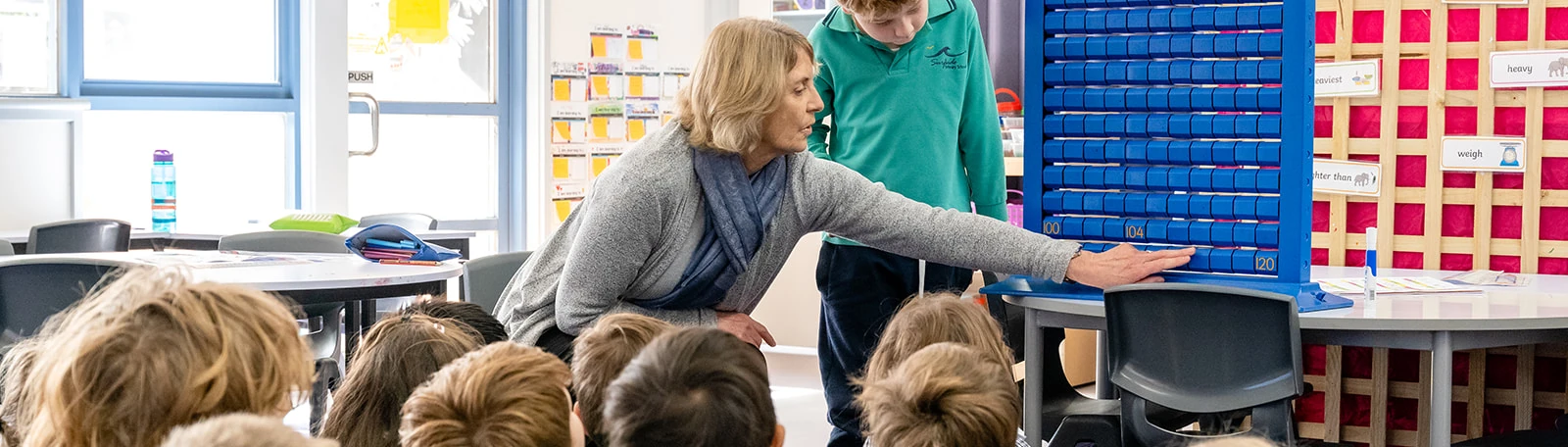
We use explicit instruction to make learning visible. Teachers clearly explain and model new concepts, guide students through worked examples and provide opportunities for supported practice before students apply their learning independently. This approach helps students develop strong foundations and confidence in their mathematical thinking.
An important part of learning mathematics is remembering what has already been taught. Through Daily Review and retrieval practice, students regularly revisit previously learned concepts, skills and vocabulary. Research shows that recalling information from memory strengthens learning and helps students retain knowledge for longer. These review opportunities allow students to connect new learning to prior knowledge and build increasingly secure mathematical understanding.
Active participation is also a key feature of mathematics lessons at Surfside. Through our engagement norms, every student is expected to think, respond and contribute throughout the lesson. Strategies such as partner discussions, mini-whiteboards, choral response and opportunities to explain thinking ensure students remain engaged and receive regular feedback on their understanding.
We recognise that becoming proficient in mathematics takes time and practice. Our teaching is informed by the Instructional Hierarchy, which supports students as they move from learning a new skill, to developing fluency, and eventually applying their knowledge flexibly in new situations and problem-solving contexts.
To ensure every student receives the support or challenge they need, Surfside uses a Multi-Tiered System of Supports (MTSS). All students access high-quality Tier 1 classroom instruction, while additional intervention or extension opportunities are provided for students who require further support or challenge. This ensures that every learner is able to make progress and experience success.
At Surfside, mathematics is more than learning procedures and facts. We strive to develop confident, capable learners who can reason, problem-solve and apply mathematics in meaningful ways. Through high expectations, strong relationships and evidence-informed teaching practices, we support every student to flourish through learning.
What a Maths Lesson Looks Like
Mathematics lessons are structured, consistent, and responsive to student needs. This predictability supports learning and behaviour, and reflects evidence-based practice from both Victorian Teaching and Learning Model 2.0, Positive Classroom Managment Strategies and the Victorian Curriculum 2.0.
A typical lesson includes:
-
Daily Review (Retrieval Practice)
Students begin by revisiting previously taught concepts. This strengthens memory, builds fluency, and ensures learning is retained over time.
-
Learning Intentions and Success Criteria
Students are clearly informed about what they are learning and what success looks like, helping them take ownership of their progress.
-
Vocabulary and Prior Knowledge
Key mathematical language is explicitly taught, and teachers activate prior knowledge so students can connect new learning to what they already know.
-
Explicit Instruction
Teachers model new learning using a structured approach:
- I Do: The teacher explains and demonstrates clearly
- We Do: Students practise together with teacher support
- You Do: Students apply learning independently
Throughout this process, teachers use responsive teaching cycles, regularly checking for understanding and adjusting instruction in real time to ensure all students are supported and challenged appropriately.
Using Data to Support Every Learner
We use ongoing assessment data to inform teaching and ensure every student receives the right level of support at the right time.
Our model includes:
- Tier 1: High-quality classroom instruction for all students
- Tier 2: Targeted small-group support for students needing additional practice
- Tier 3: Individualised, intensive intervention for students requiring further support
This ensures a consistent, inclusive approach where every child is known, supported, and extended.
Extending High-Ability Mathematicians
Students who demonstrate strong mathematical thinking are provided with enrichment opportunities through our High Abilities in Mathematics Program. This program challenges students to apply and extend their thinking in a range of meaningful contexts.
Opportunities include:
- Project 26, a collaborative workshop with SEAL students at Bellarine Secondary College, where students engage in advanced problem solving and real-world applications
- Participation in competitions run by the Australian Maths Trust, which challenge students to think flexibly and creatively
- Engagement in the Virtual Schools Victoria High Ability Program (VHAP), providing access to extension learning beyond the classroom
- Engaging in MAV Maths Games provides students with a range of challenging maths based logic challenges to complete as a team.
Importance of Fact Fluency
Fact fluency is a critical component of our mathematics program. When students can recall basic number facts quickly and accurately, it reduces cognitive load, allowing them to focus their thinking on more complex problem-solving.
We develop fluency through structured, consistent practice both at school and through digital platforms such as:
- Times Tables Rock Stars
- NumBots
Regular, short practice helps strengthen recall and supports long-term retention.
Alongside our digital program is Surfside Rocket Facts, a carefully sequenced, multisensory approach to retaining and recalling addition, subtraction, multiplication, and division facts.
How Families Can Support Learning at Home
Families play an important role in supporting confidence and growth in mathematics. You can help by:
- Promoting positive learning dispositions: Encourage persistence, curiosity, and a “can learn maths” mindset
- Connecting maths to everyday life: Talk about numbers in shopping, cooking, travel, time, and measurement
- Building fact fluency: Encourage “little and often” practice using Times Tables Rock Stars and NumBots as well as other opportunities to practice these facts.
- Engaging in learning conversations: Ask your child to explain their thinking and describe what they are learning
It takes a village…
By working together—students, teachers, and families—we create a consistent and supportive learning environment where all students can succeed in mathematics. Our approach ensures learning is explicit, structured, responsive, and evidence-informed.
For an overview of numeracy development see: https://www.education.vic.gov.au/Documents/school/teachers/teachingresources/discipline/maths/mathematics_%20teaching_toolkit_%20map.pdf